
FOR LAWYERS · GUIDE
An AI note taker
for lawyers.
Client conversations are the most confidential thing a lawyer records. Here is what the ABA and the bars say about AI that records, transcribes and summarizes them, and what to check before you use one.

What the ABA and the bars say.
Generative AI is allowed. The duties of competence and confidentiality come with it.
The American Bar Association’s Formal Opinion 512, Generative Artificial Intelligence Tools, issued on 29 July 2024, is the national reference point.1 Lawyers need not become AI experts, but they must have “a reasonable understanding of the capabilities and limitations” of the tools they use. On confidentiality it is direct: where a tool could disclose client information, “a client’s informed consent is required prior to inputting information relating to the representation”. And general, boiler-plate provisions in an engagement letter are not sufficient to get that consent. ABA opinions are advisory; your jurisdiction’s rules govern.
State bars say the same thing in practical terms. The State Bar of California’s practical guidance says a lawyer must not input confidential client information into a tool with material confidentiality or security risks without informed client consent, and that reasonable efforts require more than reliance on generalized marketing assurances.2 The Florida Bar’s Ethics Opinion 24-1 asks lawyers to research a tool’s policies on data retention, data sharing and self-learning, and notes that confidentiality concerns may be mitigated by an in-house tool rather than one where a third party hosts the data.3
When the AI records the conversation.
One bar opinion addresses exactly this: AI that records, transcribes and summarizes client conversations.
The New York City Bar’s Formal Opinion 2025-6, issued on 22 December 2025, looks at AI tools that record, transcribe and summarize conversations with clients.4 When AI records a call, it says, clients must be notified and their consent obtained. Lawyers must safeguard the recordings and transcripts. The opinion says they should also consider the tool’s safeguards: where data is stored and for how long, whether it is used for training, and whether it can be deleted. If a lawyer or firm adopts a policy not to keep recordings and transcripts, the opinion says that policy should be disclosed and strictly followed. The opinion also warns lawyers not to rely on AI to decide whether a recording is lawful, and notes that some states regulate voiceprints as biometric data.
“…clients must be notified, and their consent obtained, whenever their calls are being recorded by an AI-empowered system.”
New York City Bar, Formal Opinion 2025-6
Recording law: one party or all parties.
Federal law lets a person record a conversation they take part in, or one where a party has given prior consent, unless the purpose is a criminal or tortious act.5 Many states follow that one-party rule. Others, such as California, require the consent of all parties to record a confidential communication.6 State laws differ, and a call can cross several. Check the law for every participant’s location, and ask first.
Not legal advice. This page summarizes public opinions and statutes as of 20 October 2026. Ask your ethics counsel about your jurisdiction and your matters.
What to check before a tool hears a client.
Eight questions drawn from the opinions above.
- Where do the audio and the transcript go? Name the servers, the region and the AI providers that process them.
- Is anything used for training? Read the exact wording, and whether it is opt-in, opt-out or never.
- How long is it kept, and can you delete it? Including backups and the AI provider’s copy.
- Who at the vendor can access it? Staff, support, subprocessors.
- What does the contract promise? Confidentiality duties, breach notice, and what happens to data after the service ends.
- Have you told the client? Specific informed consent, not a general clause in the engagement letter.
- Is the recording lawful for every participant’s location?
- Who supervises? A firm policy for lawyers and staff who use the tool.
Where a local recorder changes the questions.
Fewer parties hold the conversation. The duties stay.
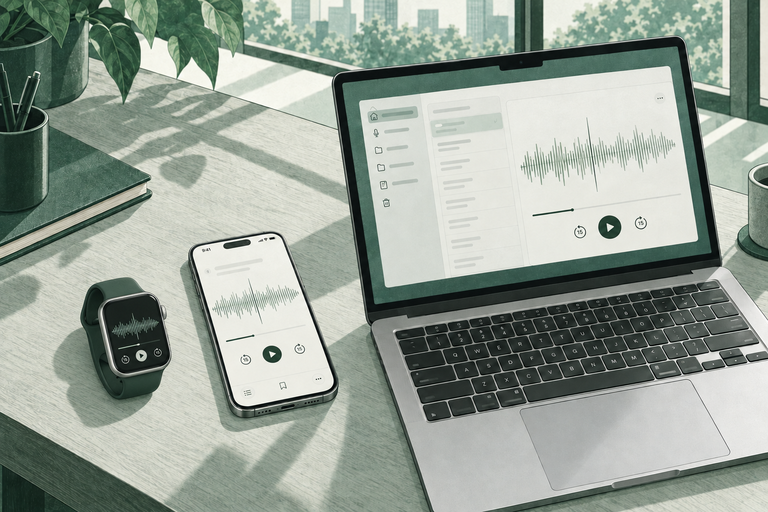
Locus records on your Mac, Apple Watch or iPhone and writes the transcript, summary and next steps on your Mac with local AI. No cloud AI is required, no bot joins a call, and the recordings and notes are files in a folder you choose on your Mac. Sharing a note or choosing an external AI service is a separate action you take.
That shortens the first five questions on the list: the local workflow does not send the meeting to a cloud AI provider. It does not answer the last three. You still tell the client, you still check the recording law, and your firm still needs a policy. For calls, the Mac records your microphone and, with Include Mac audio, the other sides of the call; no bot joins, so nobody is told automatically; the NYC Bar’s point on notice and consent applies all the same.
How local meeting transcription works · What six AI note takers state in their policies

 Guide
 Product
 For therapists