
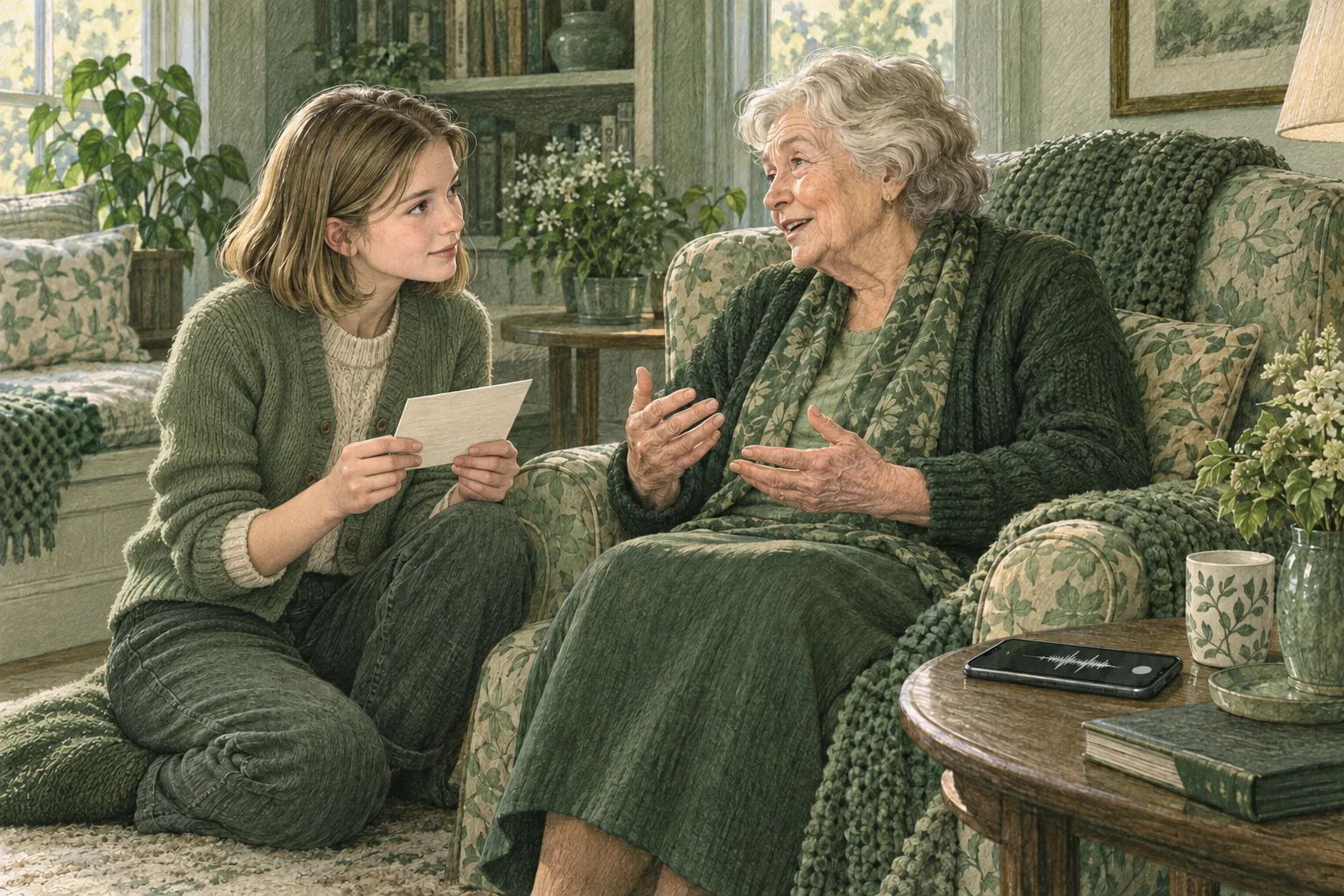
Quick answer
- Pick one life stage per visit: childhood, school, work, love and family, places, hard times, or advice.
- Choose six to eight questions. One good story is worth more than a finished list.
- After each answer, use a follow-up: "What did that look like?" "Who else was there?"
- Ask before you record, keep the session short, and let them skip any question.
How to use this list
Do not read all 42 questions in one afternoon. Print one group, cut the questions into cards, and let your grandparent pick. Open questions such as "Tell me about…" bring stories; yes-or-no questions bring one word.
The same questions work as life story interview questions for a parent: ask "What was I like as a child?" in place of question 22. Questions 12, 25 and 42 come from StoryCorps, which keeps a longer free list of great questions by topic if you want more.
Questions to ask grandparents about their childhood
- Tell me about the street you lived on. Who lived next door?
- Who did you share a bedroom with?
- What chores did you have, and which one did you hate?
- What games did you play outside?
- What did your family do on holidays?
- When did you get in trouble, and what happened?
Questions about school
- How did you get to school each day?
- Which teacher do you still remember, and why?
- What subject came easy, and which one was hard?
- Who was your best friend at school? What happened to them?
- What did you want to be when you grew up?
- Did you enjoy school?
Questions about work
- How did you earn your first money?
- Tell me about an ordinary workday. What time did it start?
- Who was the best boss you had? The worst?
- What skill from work are you proud of?
- Was there a job you wanted and did not get?
- When did you stop working, and how did that feel?
Questions about love and family
- What was your first date like?
- What did your family think of your partner at first?
- Tell me about your wedding day, or the day you decided to stay together.
- What was my mom or dad like as a child?
- What surprised you about being a parent?
- What traditions did you bring from your own family?
Questions about places and family history
- Where are your parents' families from?
- Did anyone in the family move to a new country or city? Why?
- Which house felt most like home?
- What did the town look like then? What is gone now?
- Which family names or places should I write down before they are lost?
- Is there an object in this house with a story behind it?
Questions about hard times
Save these for a later visit, after a few easy sessions. Say first that they can skip any question.
- What was the hardest year of your life? What got you through it?
- Was there a time when money was very short?
- Who did you lose too early? What do you remember about them?
- Did a war, a strike or an illness change your plans?
- Who helped you when you needed it?
- Is there something you wish had gone differently?
Questions about advice and what matters
- What do you know now that you wish you knew at 20?
- What is the best decision you ever made?
- What should our family never forget?
- What do you hope my generation does differently?
- What makes a good day for you now?
- How would you like to be remembered?
Follow-up prompts that open a story
The first answer is the headline. The story comes after the follow-up. Keep these on a card on your knee:
| Follow-up | When to use it |
|---|---|
| "What did that look like?" | For a place, a room or an object. It brings colors, smells and details. |
| "Who else was there?" | For an event. It brings names you can write down. |
| "What happened next?" | When a story stops halfway. |
| "How did you feel about that?" | After facts, gently, once per story. |
| "Why do you think that was?" | For decisions: a move, a job, a marriage. |
| "Can you show me?" | When a photo, a letter or a ring is in the room. |
Tips for a gentle session
- Keep it short. Stop at 30 to 45 minutes, or sooner if they tire. You both leave wanting another visit.
- Use photos as prompts. Put one old photo on the table and ask "Who is this?". A face starts a story faster than a question.
- Let silence sit. When an answer seems finished, wait. Count to five. The best part can come after the pause.
- Follow their thread. If a school question turns into a story about a brother, go with it. The list is a guide, not a script.
- Do not correct them. If a date sounds wrong, note it and check later. Their memory is the record of how it felt.
- End on a light question. After a hard topic, close with a happy memory or a favorite song.
Record with their permission
Ask before you press record, and say who will hear it: "I want to keep this for the grandchildren. Is that all right?" Tell them they can skip any question, take a break or stop. The Oral History Association's guidance for participants says the same. If they ask you to delete a part, delete it.
Put the iPhone flat on a table near them and open Voice Memos. For the full setup and how to keep the files, see the best way to record your grandparents' stories. For a planned series with a release form, see how to record oral history at home.
HOW LOCUS FITS
Find every answer again, across all the visits
Locus records on Apple Watch or iPhone, and the iPhone app transfers the recording to your Mac.
The Mac app transcribes each session, writes a summary, and answers questions across your recordings, such as "What did Gran say about the bakery?". All of that runs on the Mac with local AI; no cloud AI is required. An external AI service is an optional, separate choice; when it is on, that text leaves the device.
Transcription and summaries run on your Mac. Device transfer can use an encrypted relay, with Remote Access enabled by default. A cloud-synced library folder still syncs. Review these settings before recording family stories. The app is in preview. It needs a Mac with Apple Silicon M3 or later, 24 GB of unified memory or more, and macOS 27 or later. Watch recordings need the iPhone app. Voice Memos records the session today and can show a transcript on iPhone 12 or later in supported languages and regions.
Join the waitlistQuestions people ask
What are good questions to ask grandparents about their life?
Open questions about one stage of life at a time. Start with childhood and places: the street they lived on, the chores they hated, the games they played. Move to school, work, and love and family on later visits. Keep hard times for after a few easy sessions. Follow each answer with "What did that look like?" or "Who else was there?".
What questions should I ask my grandparents before they die?
Ask what you would regret not hearing: family names and places, how they met their partner, what your parent was like as a child, and the advice they want passed on. Do not frame the visit around death. Ask gently, one topic per visit, and let them skip anything. Record with their permission so the family can hear the voice later.
How many questions should I ask in one session?
Six to eight is enough for 30 to 45 minutes. One question can fill 20 minutes when you follow up and let silence sit. Pick one group from the list, let your grandparent choose the order, and stop while they still enjoy it. Plan the next group for the next visit.
What are good oral history questions for family history?
Questions about origins, moves and names. Ask where their parents' families came from, why anyone moved, which houses felt like home, and which names and places you should write down. Ask about objects in the house with a story. Note spellings after the session. For a planned series with a release form, see How to Record Oral History at Home.
Can Locus help me keep track of my grandparents' answers?
Locus records on Apple Watch or iPhone and transfers each recording to a Mac. The Mac app transcribes and summarizes each session with local AI and answers questions across them, so you can find what Gran said about the bakery months later. No cloud AI is required. The app is in preview and needs a Mac with Apple Silicon M3 or later, 24 GB of unified memory or more, and macOS 27 or later.
Sources
- Great Questions (StoryCorps) — question list by topic; three questions quoted, checked 2026‑10‑23.
- For Participants in Oral History Interviews (Oral History Association) — right to skip questions, take breaks and stop, checked 2026‑10‑23.
- Make a recording in Voice Memos on iPhone (Apple Support) — recording steps, checked 2026‑10‑23.
- View a Voice Memos transcription on iPhone (Apple Support) — transcript on iPhone 12 or later, checked 2026‑10‑23.